

Reviewed · MILAN ESCAPE GAMES & HUNTS
e-Scavenger hunt Milan: Explore the city at your own pace
Milan, but make it a game. This app-led e-scavenger hunt turns Milan’s big-name sights into a walk you can do at your own tempo, with prompts and answers that keep you moving. I like the flexibility: you’re not stuck waiting on a group, so you can linger when something catches your eye and move on when it doesn’t. I also like how it nudges you to notice details at several landmarks instead of doing a drive-by photo stop.
One thing to consider: this is built around your phone, and smartphone and data aren’t included. If you’re hoping for a traditional guide who explains everything in person, you may feel let down. Also, because it’s an app game first and a narration second, you’ll want to be comfortable following instructions on your screen while you walk.
In This Review
- Key things to know before you play
- Why this app-led hunt works in Milan
- The route: how the landmarks line up for a good walking flow
- Galleria Vittorio Emanuele II: start with a landmark that feels like a shortcut
- Milan Cathedral (Duomo): the big square test
- Castello Sforzesco: when the game shifts from cathedral to fortress
- Last Supper: a major artistic moment built into the walk
- Porta Sempione: a city gate that also means a district
- San Fedele: a specific church with a clear dedication
- Casa Panigarola (Palazzo dei Notai): medieval city center context
- Basilica of San Lorenzo Maggiore: Roman times in the canal ring
- The fountain detail: Giuseppe Bovara’s water setup
- Basilica di Santa Tecla: a former early-Christian layer
- A church roof with statues and false apse trompe-l’œil
- Brera and Pinacoteca di Brera: art-focused Milan time
- Santa Maria delle Grazie: UNESCO context ties it together
- Palazzo Litta: Baroque finale energy
- Who this is best for (and who may want a different plan)
- Price and time: is $36.07 per group a smart value?
- Practical tips to make your hunt feel smooth
- Should you book e-Scavenger hunt Milan?
- FAQ
- FAQ
- How much does the e-Scavenger hunt Milan cost?
- How long does the experience take?
- Where does the hunt start?
- Where does it end?
- What do I need to play the game?
- Does it run at specific hours?
- Is this a group tour or private?
- Is it family-friendly?
- What’s the cancellation policy?
Key things to know before you play
- Self-paced route: set your own pace across central Milan without group pacing
- Game-style learning: questions and research prompts linked to major sights
- Smartphone required: plan for phone and data (not included)
- Family-friendly: designed to work well for all ages
- A long list of icons: Duomo area, Castello Sforzesco, Last Supper, Brera, and more
- Private for your group: only your group participates (up to 6)
More puzzles set loose across Milan
- Sato Code Escape Room across Milan★ 5.0 · 9 reviews
- Sato Code Escape Room across Varese★ 5.0 · 8 reviews
- Milan: Treasure Hunt & Walking Tour★ 4.1 · 8 reviews
Why this app-led hunt works in Milan
Milan can be intimidating at first—big streets, big architecture, and a lot of people. This experience tackles that by turning “figure it out” into a simple mission: walk, check your phone, answer, move on. The route is built around recognizable places, but the way you experience them is different. Instead of reading a plaque for 30 seconds and forgetting it, you’re nudged to actually engage with what you’re seeing.
The value here is in pacing. You can choose your rhythm and your stops. If you want a fast circuit through Galleria Vittorio Emanuele II and into Duomo Square, you can. If you want to slow down near a church or a museum area, you can do that too—no group argument about who’s hungry and who wants one more photo.
Price also matters. At $36.07 per group (up to 6), you’re not paying per person for the privilege of walking. For families, friends, or two couples, that can be a good deal—especially in a city where paid guided walks can climb fast.
The route: how the landmarks line up for a good walking flow
The hunt is designed as a city walk of about 2 to 4 hours. It starts and ends back at Piazza Fontana (20122 Milano MI), which is handy because you don’t have to worry about a separate drop-off. And since it’s a mobile ticket, your day is more about walking and playing than tracking paperwork.
What you’ll do is simple: you’ll follow the app, hit each checkpoint, answer questions, and complete small assignments. The exact order feels like a guided loop through Milan’s classics—then you get the freedom to pace yourself once you’re there.
Galleria Vittorio Emanuele II: start with a landmark that feels like a shortcut
You begin at the Galleria Vittorio Emanuele II, described as Italy’s oldest active shopping gallery and a major Milan landmark. This is a smart first stop for a game because it’s easy to orient yourself quickly. It also sets a clear theme for Milan: style, shopping energy, and architectural ambition.
If you like “warm-up” moments, this works. You get your phone ready, scan in, and start understanding how the game expects you to look and answer.
Practical tip: If your phone battery is shaky, this is where I’d make sure everything is charged before you move deeper into the rest of the route.
A few more we would happily send a friend to in Milan
- Milan: City Sightseeing Hop-On Hop-Off Bus with Audio Guide
★ 4.0 · 6,256 reviews - Milan: Official City Pass with Duomo and Over 10 Attractions
★ 4.4 · 1,186 reviews - Transfer Milan City Centre – Bergamo Airport
★ 4.5 · 975 reviews - Milan: The Milan Pass City Card
★ 4.0 · 655 reviews - From Milan: Day Trip to Venice with Guided City Tour
★ 4.4 · 614 reviews
Milan Cathedral (Duomo): the big square test
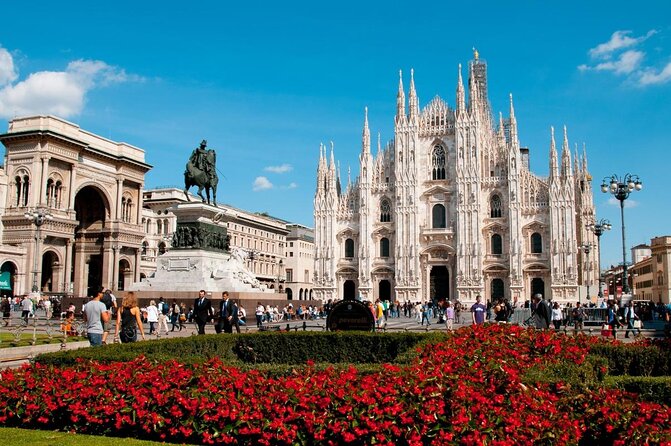
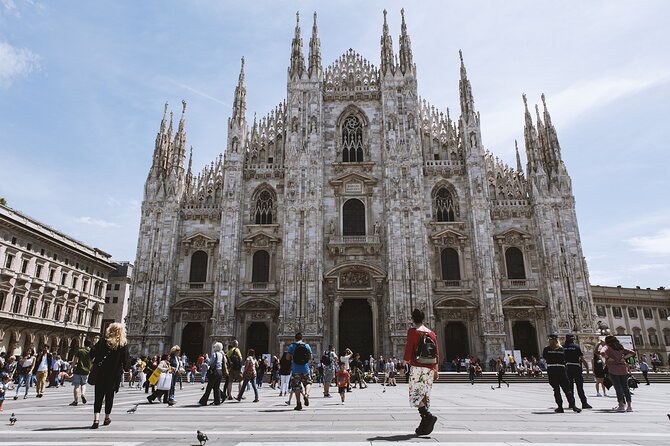
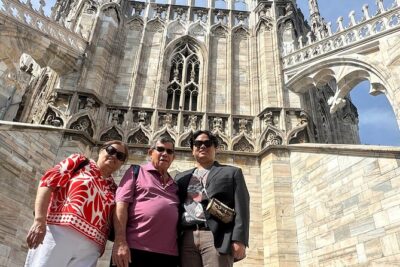
Next comes the Milan Cathedral, officially the Metropolitan Cathedral-Basilica of the Nativity of Saint Mary. Then you reach Duomo Square, enclosed by the gothic cathedral. It’s also noted that shopping draws many crowds here, so expect foot traffic.
For a scavenger hunt format, Duomo Square is ideal: even if you don’t want to go inside, you can still play. The app can keep you focused on what to notice and what to answer while the plaza does its thing around you.
Consideration: This is a place where crowds and slow-moving people can affect your walking pace. Since you’re self-paced, you can pause without needing to apologize to a guide.
Castello Sforzesco: when the game shifts from cathedral to fortress
Then you head to Castello Sforzesco, a medieval fortification built in the 15th century. This is another good checkpoint because it adds a different kind of Milan: not only religious grandeur and shopping arcades, but also defense-era structure and historic atmosphere.
In a game context, fortress architecture tends to be easier to describe through prompts—lines, shapes, and the feeling of a wall around you.
Last Supper: a major artistic moment built into the walk
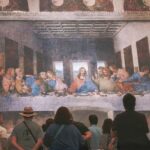
The next landmark is The Last Supper, a late 15th-century mural by Leonardo da Vinci, housed by the refectory of the Convent of Santa Maria delle Grazie. This is arguably the most famous cultural stop on the list, and it’s powerful even when you’re just walking through the area.
Because the mural is specifically linked to its building, the game format makes sense: it can guide you toward the right context without you needing a separate museum explanation right then.
Why this matters for value: You get a sequence that includes both the landmark and the connection—so you’re less likely to leave with only a vague memory of what you saw.
Porta Sempione: a city gate that also means a district
After the heavyweights, the route includes Porta Sempione, described as a city gate of Milan. The name is used both for the gate and for the surrounding district. That detail is useful for scavenger-hunt thinking: you can learn the difference between a single structure and the neighborhood identity wrapped around it.
It’s also a breather. Gate areas can feel more open than cathedral plazas, and that can help your legs after earlier landmarks.
San Fedele: a specific church with a clear dedication
You’ll also find San Fedele, a Jesuit church in northern Milan dedicated to St. Fidelis of Como, patron of the Catholic diocese of Como. This is the kind of detail that app-led questions often turn into quick wins: you’re not just seeing a façade; you’re connecting it to a name and a role.
If you like knowing what you’re looking at—without turning your day into a textbook—this sort of prompt structure is exactly where it shines.
Casa Panigarola (Palazzo dei Notai): medieval city center context
Next is Casa Panigarola, also known as Palazzo dei Notai, a historic building located in Piazza Mercanti, described as the former city centre in the Middle Ages. This is one of those stops that sounds small until you realize the location itself is tied to Milan’s older center.
For you, that means the scavenger hunt isn’t only about famous targets. It also gives you a chance to build a timeline of the city through where things were, not just what they look like.
Basilica of San Lorenzo Maggiore: Roman times in the canal ring
Then comes the Basilica of San Lorenzo Maggiore, described as a church in northern Milan located within the city’s ring of canals. It was originally built in Roman times.
That canal-ring detail is interesting because it frames the basilica as part of a broader urban layout. In a self-paced walk, that kind of context can turn a quick stop into something you actually remember.
The fountain detail: Giuseppe Bovara’s water setup
At one point you’ll encounter a rectangular fountain designed by architect Giuseppe Bovara. The description is very specific: water gushes out through three mouths—two lateral and one front.
I love when hunts include details like this. It gives you a clear thing to look for, not just a broad “nice fountain” moment. It’s also a great example of what the app format can do well: it can point you to the part that most people miss.
Basilica di Santa Tecla: a former early-Christian layer
The route also references Basilica di Santa Tecla, described as a former paleo-Christian basilica church in Milan. Since it’s framed as former, you’re probably meant to treat it as part of Milan’s layers rather than a single modern attraction.
This is where the game approach can help you slow down: the app can guide you through why the site matters, even if it’s not your usual top-10 tourist stop.
A church roof with statues and false apse trompe-l’œil
Another highlight in the list is a church described as having roof statues, not just gargoyles. It’s also known for its false apse, an early example of trompe-l’œil, attributed to Donato Bramante.
Even without standing there for an hour, this is a wow-type fact. It’s the sort of thing you can forget easily unless you’re forced to notice it and connect it to the description. A scavenger hunt format is good at that: you’re actively searching for the features that match the clue.
Brera and Pinacoteca di Brera: art-focused Milan time
Then you move into Brera, described as part of the Centro Storico district. It’s home to the Pinacoteca di Brera gallery and its collection of Italian art spanning centuries, and it’s described as fresco-filled.
Brera is also a nice change from churches and squares. It’s more about atmosphere and culture—an area where the walk itself feels like a gallery.
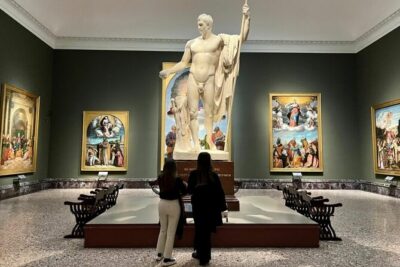
Then you reach the Pinacoteca di Brera, described as Milan’s main public gallery for paintings, and one of the foremost collections of Italian paintings. For art lovers, this checkpoint fits the Milan fantasy: you’re pairing streets with indoor culture without having to plan a full standalone museum day.
Santa Maria delle Grazie: UNESCO context ties it together
Near the end, the route includes Santa Maria delle Grazie, described as a church and Dominican convent in Milan and a UNESCO World Heritage Site. This is a meaningful stop because it connects back to the Last Supper area.
If you’re the type of person who likes your facts to connect (rather than bouncing around), this helps. The mural isn’t floating in the void; it’s tied to a place with recognized status.
Palazzo Litta: Baroque finale energy
Finally, you’ll see Palazzo Litta, also known as Palazzo Arese-Litta, described as a Baroque structure in Milan. A palace closing is a good choice: it gives the walk a strong “finish” feel, and it’s a different architectural style than what you started with.
Who this is best for (and who may want a different plan)
This works especially well if you’re the kind of traveler who:
- likes walking at your own pace
- enjoys answering questions and doing light research on the fly
- wants a family-friendly activity that isn’t just sitting indoors
- has a small group (up to 6) and wants to keep cost per person reasonable
It may be less satisfying if you want:
- a traditional guide who explains every stop in depth, in real time
- a tour that does not rely on app instructions while you’re outside
- a plan that works well even when your data connection is weak (because data and smartphone use are on you)
And if you’re sensitive to tech that sometimes doesn’t match your expectations, plan accordingly. One of the key downsides reflected in a negative experience was disappointment with the explanation and the feeling that it wasn’t what was expected—so your best move is to make sure you’re genuinely comfortable with an app-first format before you start.
Price and time: is $36.07 per group a smart value?

At $36.07 per group (up to 6) for about 2 to 4 hours, this can be a strong value—especially because you’re buying a self-paced activity that covers multiple landmarks in one route.
Where the math gets tricky is the “hidden costs” that aren’t money but effort: you need a usable smartphone and data. If your phone battery is low or your connection is unreliable, that can turn the experience from smooth to stressful fast.
Still, if you’re traveling with a group, the per-person cost becomes more reasonable. And Milan is a city where you can burn hours just navigating, so saving planning time has value too.
Practical tips to make your hunt feel smooth
Here are a few ways I’d set you up for success based on how these app-style walks work.
- Charge before you go. This is a phone-dependent route.
- Set expectations for pace. You’ll spend more time reading prompts than you would on a casual stroll.
- Start early in your day. The route crosses very busy areas like Duomo Square, and you’ll have a better time if you’re not arriving when the crowds peak.
- Keep your eyes open for specific details. The fountain description and the Bramante trompe-l’œil-style false apse are exactly the kind of things the app can point out well.
- Use transit nearby. The meeting point is near public transportation, which makes it easier to fit into your schedule.
Should you book e-Scavenger hunt Milan?

Book it if you want a self-paced, game-style way to see Milan’s major highlights—especially if you like learning through questions and you’re traveling in a group size that keeps the cost down. It’s also a good choice when you want structure without a rigid itinerary.
Skip it if you’re craving a more traditional guided experience with clear explanations on your behalf, or if you’re not comfortable relying on your smartphone and data to get through the game. Since the format is app-first, your enjoyment will rise or fall with how well that matches your travel style.
FAQ
FAQ
How much does the e-Scavenger hunt Milan cost?
It costs $36.07 per group, with a maximum group size of up to 6.
How long does the experience take?
Plan on about 2 to 4 hours.
Where does the hunt start?
It starts at Piazza Fontana, 20122 Milano MI, Italy.
Where does it end?
It ends back at the meeting point (Piazza Fontana).
What do I need to play the game?
You’ll use an online app on your smartphone, and you’ll receive a mobile ticket. Smartphone and data are not included, so you’ll need to have those.
Does it run at specific hours?
The opening hours listed are 12:00 AM to 11:59 PM, Monday through Sunday, during the date range 12/01/2021 to 06/16/2026.
Is this a group tour or private?
It’s a private tour/activity. Only your group will participate.
Is it family-friendly?
Yes. It’s described as family-friendly and great for all ages.
What’s the cancellation policy?
You can cancel for a full refund if you cancel at least 24 hours in advance. If you cancel less than 24 hours before the start time, the amount paid is not refunded.
More City Tours in Milan





More Tour Reviews in Milan





More Milan Escape Games and Hunts






Fresh in our Milan notebook



Milan Escape Games & Hunts, compared.
 ★ 5.0Sato Code Escape Room across MilanFrom $149 reviews
 ★ 4.1Treasure Hunt & Walking TourFrom $258 reviews
 ★ 5.0Sato Code Escape Room across VareseFrom $128 reviews
 ★ 4.5Milan Scavenger Hunt and Best Landmarks Self Guided TourFrom $87 reviews
 ★ 5.0Milan Treasure Hunt for Groups of Friends, Team Building & Company IncentivesFrom $985 reviews
 ★ 4.5Sato Code Escape Room across MonzaFrom $115 reviews
Browse the lists this tour appears in